As the global energy transition accelerates, the demand for high-efficiency photovoltaic (PV) solutions has shifted from static installations to dynamic, intelligent tracking systems. Shandong Zhaori New Energy Tech. Co., Ltd. (Sunchaser) stands at the forefront of this revolution, providing advanced mechanical architectures that increase energy yield by up to 40% compared to traditional fixed systems.
In the current industrial landscape, "Information Gain" in solar asset management refers to the ability of a tracking system to process real-time meteorological data and adjust panel orientation to capture diffuse radiation during cloudy periods or optimize backtracking to prevent row-to-row shading. This white paper explores the technical depth, economic feasibility, and manufacturing excellence of track solar systems.
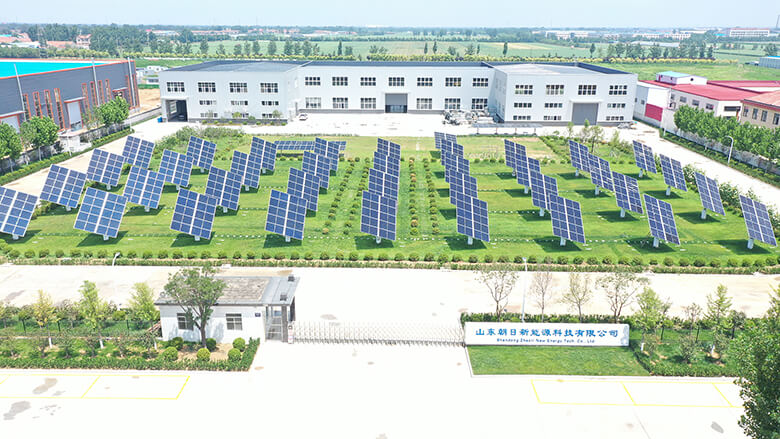
Founded in June 2012, Shandong Zhaori New Energy Tech. Co., Ltd. operates out of a state-of-the-art 50,000 square meter facility. With 10 specialized departments including R&D, Quality Assurance, and Engineering, we employ over 60 high-level technical talents dedicated to PV power station optimization.
Our production environment integrates CNC machine tools, laser cutting machines, and automatic welding robots, ensuring that every bracket and tracker meets rigorous international standards. Our manufacturing principle is centered on Simplicity, Reliability, and Effectiveness, reducing the complexity of O&M (Operation and Maintenance) while maximizing structural integrity.
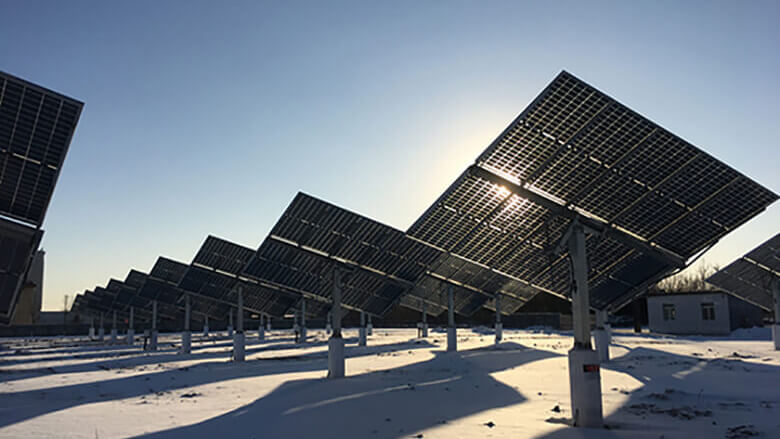
The pinnacle of solar harvesting. By tracking both the azimuth and altitude angles, the ZRD-08 and ZRD-10 systems ensure the sun's rays are always perpendicular to the PV module surface.
A balanced solution for cost-efficiency. Our flat and tilted single-axis systems offer a significant boost in production with lower capital expenditure.
For regions with extreme terrain or budget constraints, our manual adjustable brackets provide a seasonal optimization path without the cost of motors.
| Technology Type | Model Series | Degree of Movement | Estimated Gain | Best Application |
|---|---|---|---|---|
| Dual Axis | ZRD-06/08/10 | 360° Horizontal, 0-90° Vertical | 35-40% | Utility Scale, Residential High-Yield |
| Tilted Single Axis | ZRT-16 | Azimuth Tracking (10-30° Tilt) | 20-25% | Desert & Mountainous Terrains |
| Flat Single Axis | ZRP 1P/2P | Horizontal Tracking | 15-30% | Flat Utility Sites, Bifacial Modules |
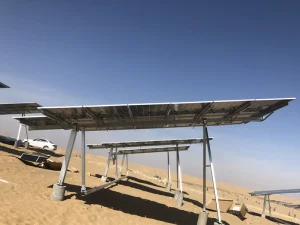
Specialized dust-proof actuators and sand-resistant slewing drives designed for projects in MENA and Central Asia. Our 20MW desert projects demonstrate 99% uptime in harsh environments.
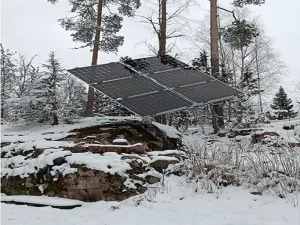
Intelligent "Snow Mode" allows trackers to tilt to a steep angle, preventing accumulation that could damage structural components, as seen in our North China installations.
Optimized for rooftop and facility adjacent land, providing maximum power density to reduce carbon footprints for corporate ESG goals.
Procuring solar trackers involves more than just the price per watt. Sunchaser provides a transparent pricing model based on:
The next decade of solar tracking will be defined by Machine Learning (ML). Sunchaser is currently developing next-generation trackers that utilize Computer Vision to detect cloud movement and optimize the angle for diffuse light, rather than just following the geometric position of the sun. This "Information Gain" approach ensures that even on overcast days, energy production is maximized.
We are integrating IoT sensors into our ZRD and ZRP lines to provide real-time structural health monitoring. This predictive maintenance reduces the need for manual inspections, lowering the long-term O&M costs for asset owners.
Trust is the foundation of renewable energy investment. Shandong Zhaori's commitment to quality is backed by rigorous global certifications:
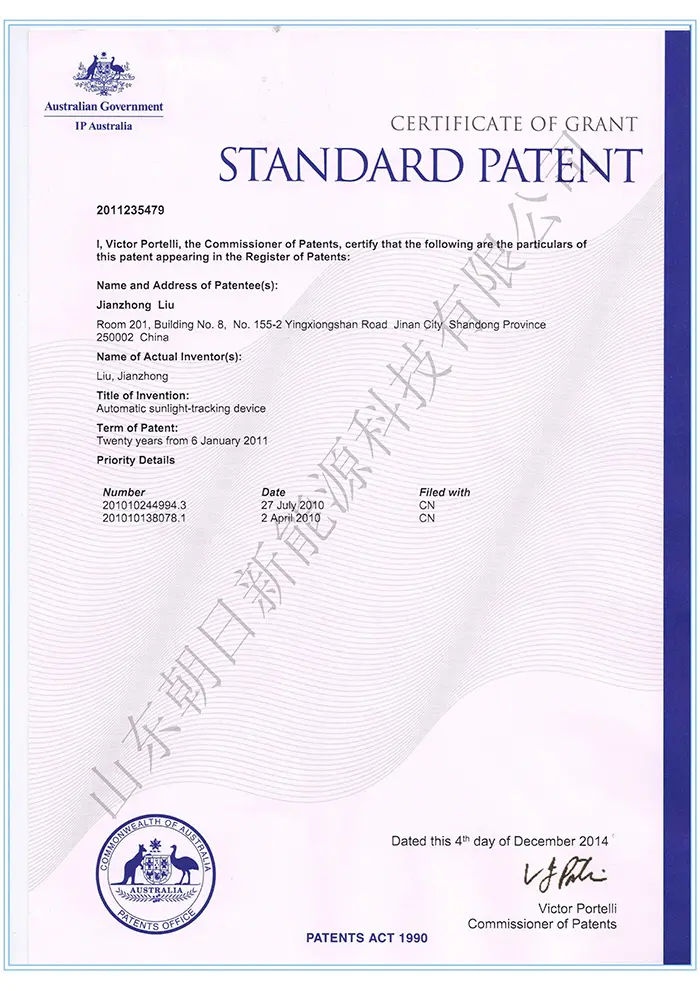
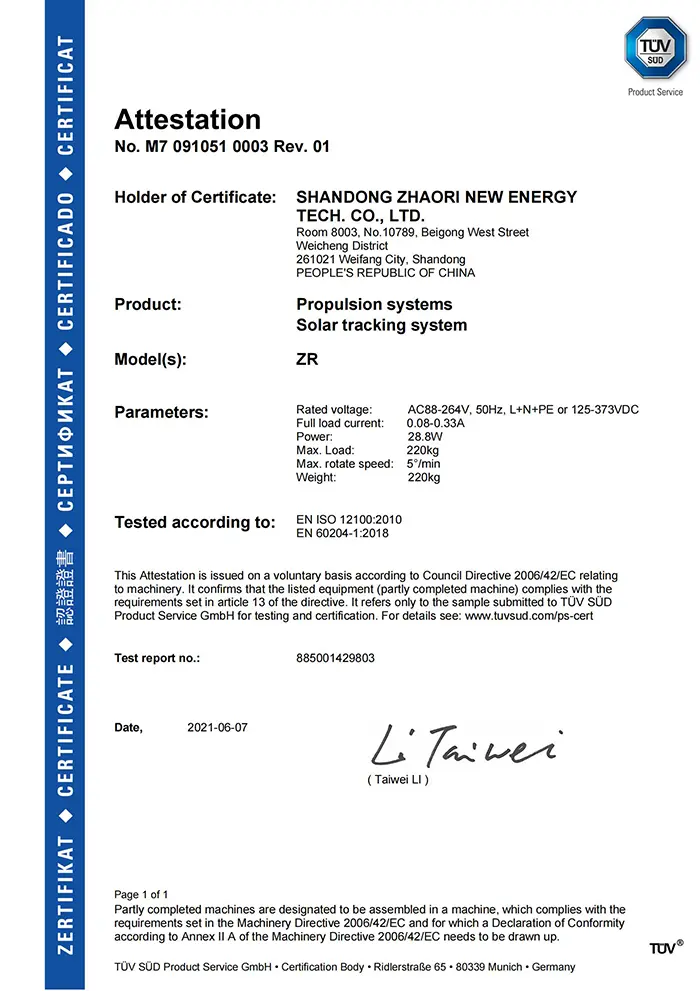
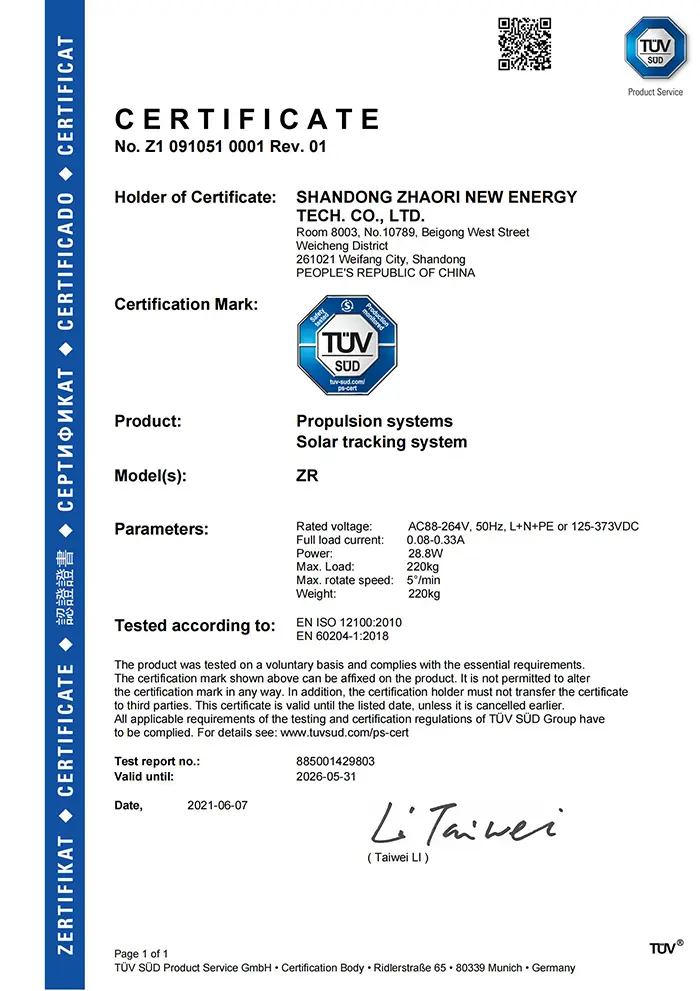
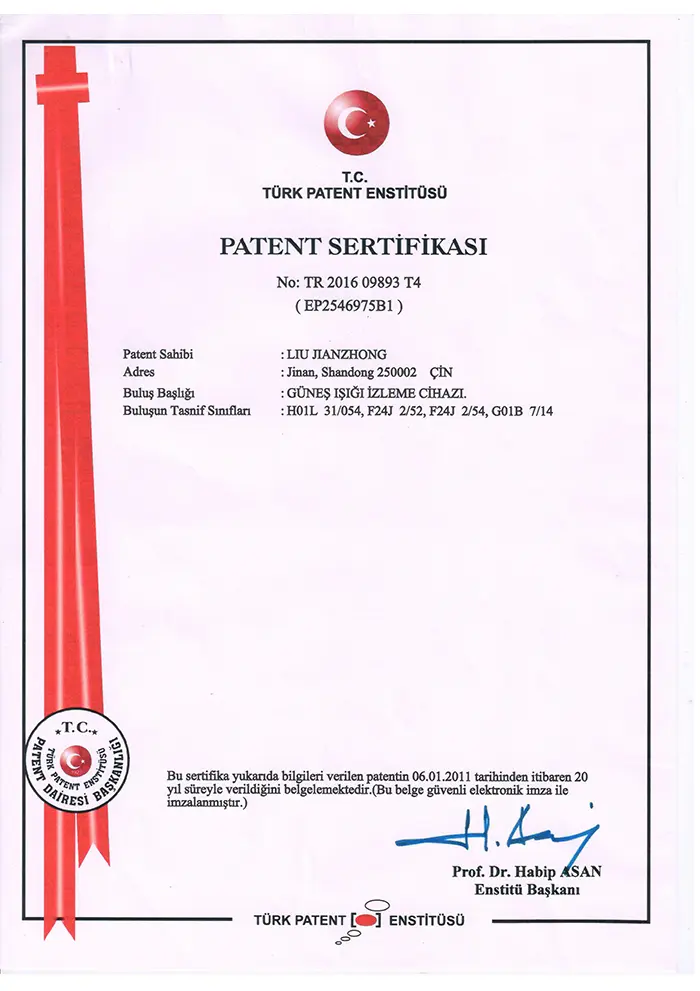
Our products hold patents in the USA, Canada, Europe, Australia, Japan, South Korea, India, and Brazil. This global IP portfolio ensures that our clients are protected and compliant with local grid codes and construction standards worldwide.
Utility Scale: 353MW Flat Single Axis Project
High Yield: Dual Axis Precision Tracking
Depending on the location's GHI (Global Horizontal Irradiance), most utility-scale projects see a payback period reduction of 1.5 to 2.5 years compared to fixed systems, thanks to the 20-40% increase in energy production.
Our systems feature an automated stow mode. When wind sensors detect speeds exceeding 18-22 m/s (adjustable), the trackers move to a horizontal position to minimize wind load and prevent structural failure.
Yes. Our ZRP 2P and 1P designs are specifically engineered to eliminate shading on the rear side of the modules, maximizing the bifacial gain which can add another 5-10% to the total energy yield.
We provide comprehensive installation guides, remote technical supervision, and a localized spare parts strategy to ensure any downtime is minimized regardless of your project's location.
 Zhaori